Product Demonstrator Staffing for Trade Show Booths: A Planning Guide
How to staff hands-on booth demos: the roles you need, stations per shift, script certification, lead handoff and a recovery plan for when a demo fails.
Independent guide by TLC Models. Details were accurate when verified — confirm with each venue before booking.
A hands-on demo is the most persuasive minute your booth will ever have, and it depends entirely on the person running it. A product demonstrator who knows the script, keeps the station moving and hands interested visitors to a qualifier turns foot traffic into pipeline. One who improvises, stalls or lets a crowd drift away costs you the conversation.
Most exhibit-house advice covers demo station design and stops at the carpet edge. This guide covers the people: when to use in-house engineers and when to use trained demonstrators, how to certify a script, how many stations a shift can support, how to log demo interest in your lead app, and what to do when the product fails mid-demonstration.
It is written for marketing and event leads planning a trade show presence. If you want a team assembled for your booth, our trade show staffing team can build it, and you can start at booking request.
The quick answer: how to staff a product demonstrator team
Staff each live demo station with one product demonstrator per shift, add a qualifier who captures and scores leads, and keep a rotation relief person for every few stations. Use your own engineers or technical product specialists for deep technical questions, not for running the station all day.
The core of a strong demo team is a short, certified script, a station that resets in under a minute, and a clear handoff from the demonstrator to the qualifier. A demonstrator should show, explain and invite; the qualifier should ask the questions that decide whether the visitor is a real prospect.
Plan on a written recovery plan for equipment failure, and brief every person on it before doors open. Everything below turns that answer into numbers, roles and a timeline you can apply to your booth.
The roles you need and what each does
A demo booth works best when each person has one job. Blurring roles is the most common reason a station stalls.
- Product demonstrator: runs the scripted demo, keeps the station clean and ready, and draws visitors in. Their job is to show the product, not to negotiate or qualify.
- Technical product specialist: an engineer or product expert who handles detailed questions, integration topics and anything beyond the script. Keep them available rather than tied to a station.
- Qualifier or lead capture lead: takes the handoff, asks the agreed qualifying questions and logs the lead with demo interest noted.
- Greeter or flow host: invites visitors to an open station and manages the queue so demonstrators are not interrupted mid-demo.
- Floor lead or supervisor: manages the rotation, covers breaks, resolves problems and keeps the team on script.
In-house engineers versus trained demonstrators
Engineers know the product best, but they are often the wrong people to deliver the same demo forty times a day. Trained demonstrators are practiced at pacing, energy and repetition, which frees your specialists to have the high-value conversations. A blended team usually performs best.
How many staff you need: a simple formula
Start with stations, then add support. The formula: stations x 1 demonstrator, plus 1 qualifier for every 2 stations, plus 1 relief person for every 3 to 4 stations to cover breaks, plus 1 floor lead for anything above two stations. These are planning assumptions, not fixed rules; adjust for demo length and expected traffic.
Assumptions: each demo is a short, scripted run, the station resets quickly, and the show is a full-day format with staff breaks.
- Small booth (one station): 1 demonstrator, 1 qualifier who can also relieve. A technical specialist on call from your own team.
- Mid-size booth (two to three stations): 2 to 3 demonstrators, 1 to 2 qualifiers, 1 relief person.
- Large booth (four to six stations): 4 to 6 demonstrators, 2 to 3 qualifiers, 1 to 2 relief people, 1 floor lead and a greeter.
- Island or flagship (seven or more stations): scale the same ratios, add a second greeter and a dedicated floor lead per zone.
Stations per shift
Do not run every station at full strength all day. Open your highest-traffic stations first and add others as the aisle fills. A demo rotation schedule that moves demonstrators between stations also keeps energy high and prevents voice fatigue.
What drives the cost of product demonstrator staffing
Cost depends on a handful of variables rather than a single rate, so set aside a range once you have your station plan.
- Number of stations and shift hours: more stations and longer show days increase the headcount and hours.
- Skill level: a demonstrator running a technical product needs more training than one showing a simple consumer item.
- Training and rehearsal time: paid briefing and script certification before the show are an investment that protects the rest of your spend.
- Travel and lodging: staffing local talent in the show city reduces these costs.
- Lead time: shorter notice can limit who is available.
- Role mix: qualifiers, relief and floor leads add to a team but protect results.
The smart-spend move is to invest in a tighter script and well-trained people at fewer stations rather than thinly covering many. A well-run station produces more qualified conversations than several unstaffed or poorly run ones.
Booking timeline for demo staff
Earlier is better for training, but you are not locked out if plans change. TLC offers 48-hour staffing for urgent needs, which is useful for a late expansion or a replacement. For a planned show, use this sequence.
- Six to eight weeks out: lock your station count, demo length and role mix, and finalize the script with your product team.
- Four to six weeks out: submit your booking request with show dates, hours and station plan so talent can be matched.
- Two to three weeks out: share the script, product materials and lead app access for review.
- One week out: run a briefing and certification session, ideally with the product in hand.
- Show eve: walk the booth, test every station and confirm the recovery plan.
If your timeline is shorter, the same steps compress. Do not skip the certification run, even if it is held the evening before.
Briefing and training checklist
A short, disciplined briefing is the difference between a polished demo and a rambling one. Cover these items before doors open.
- Demo script structure: a hook, a problem, the product in action, one clear proof point and an invitation to talk further. Keep it short enough to repeat all day.
- Script certification: each demonstrator delivers the full demo to a supervisor and is signed off before working a station.
- Demo station design: where the product sits, what is within reach, and how the station resets between audiences.
- Escalation rules: which questions go to a technical product specialist and how to hand them off.
- Lead handoff: the exact words used to introduce the qualifier, and what the qualifier asks.
- Logging leads after a demo: record the visitor, the product shown, their interest level and the next step in the lead app immediately, not at the end of the day.
- Demo-failure recovery plan: a backup unit or recorded video, a calm line to buy time, and a named person who fixes the issue while the demonstrator keeps the visitor engaged.
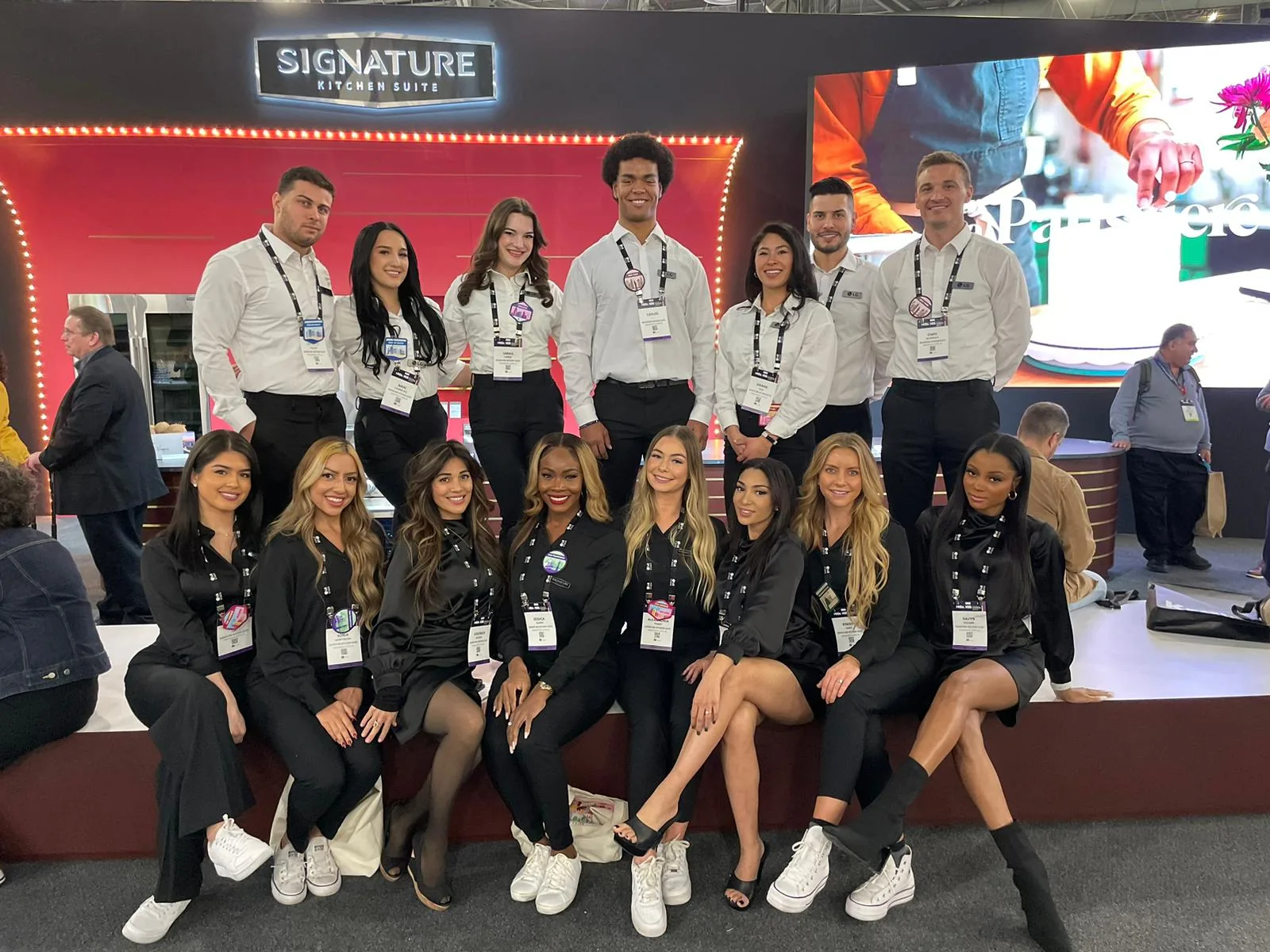
For a model of scripted demo teams at scale, see the LG Electronics case study.
Agency vs in-house vs gig apps
You have three ways to fill demo roles, and they differ on risk and consistency.
- In-house staff: deepest product knowledge, but pulls engineers and sales from other work and can be inconsistent at repeating a demo.
- Gig apps: fast to find people, but quality, training and accountability vary, and replacements are your problem.
- Specialist agency: a managed team with training and supervision.
TLC Models offers W-2 talent, full insurance and background-checked staff, so you are not carrying employment risk for people on your booth floor. If someone cannot make a shift, a replacement is arranged, and a supervisor keeps the team on script during the show.
For most exhibitors, the best answer is a blend: your technical product specialists for depth, and trained demonstrators for the repeated demos. Learn more about our brand ambassadors or start a booking request.
Frequently asked questions
What is a product demonstrator?
A product demonstrator shows visitors how a product works, answers questions and encourages them to try it. At a trade show booth, the role is to deliver a scripted, hands-on demo and then pass interested visitors to a qualifier who captures lead details and next steps.
Is a product demonstrator a good job?
It suits people who enjoy talking with the public, repeating a message with energy and learning a product well. For event work, it offers varied settings and short engagements. Success depends on clear training, a good script and supportive supervision during each shift.
How many demonstrators do I need per booth?
Plan one demonstrator per live station, one qualifier for every two stations, and one relief person for every three to four stations. Add a floor lead above two stations. Adjust for demo length, expected traffic and break coverage across the show day.
Should engineers run the demos?
Use engineers or technical product specialists for detailed questions and key accounts, not for running every demo. Trained demonstrators handle repetition and pacing, which keeps your specialists free for the conversations where deep product knowledge changes the outcome.
What should I do if a demo fails?
Have a recovery plan ready: a backup unit or recorded video, a calm line to hold the visitor's attention, and a named person to fix the issue. Rehearse it in the briefing so the demonstrator stays composed and the visitor still leaves with a clear impression.
How do I log leads after a demo?
Record the lead in your lead app right after the conversation. Note the product shown, the visitor's interest level and the agreed next step. Having the qualifier do this immediately keeps data accurate and makes follow-up faster once the show ends.
How fast can I book demo staff?
TLC Models offers 48-hour staffing for urgent needs, though earlier booking allows time for script certification and a full briefing. For planned shows, submit a booking request several weeks ahead with your dates, hours and station plan.
- Drafted with AI assistance from TLC's editorial brief; fact-checked by the TLC team before publishing.
- Update log: 2026-10-09 — first draft.
Need demo staff for your booth?
Staffing an event of this scale?
Tell us the show, the city, and the headcount. We will tell you exactly how we would staff it.